When to Accelerate Rather Than Defer Taxes
Key takeaways: Tax acceleration or tax deferral
- Tax deferral can be helpful, but it isn't always the best strategy—especially if you expect to be in the same or a higher tax bracket in retirement.
- Roth contributions, Roth conversions, and early withdrawals from tax-deferred accounts can help retirees manage future required minimum distributions and gain more control over taxable income.
- A low-income year may create an opportunity to convert tax-deferred savings to Roth accounts or harvest capital gains at a lower tax rate.
- Accelerating taxes can have complex tax consequences, so speak with a qualified tax professional or your wealth advisor before taking action.
Many retirement-planning strategies revolve around the idea of tax deferral. By funding traditional 401(k)s and IRAs with pretax dollars, savers delay paying taxes on those contributions (and any earnings) until a future date, hopefully at a time when their tax burden may be lower.
But in certain situations, it can make more sense for taxpayers to pay up sooner rather than later. Here's why (and how) accelerating taxes can help manage your lifetime tax liability.
The challenge: Your tax bracket in retirement may be the same or higher
Those with tax-deferred retirement accounts will eventually be forced to take taxable annual withdrawals—known as required minimum distributions (RMDs)—whether they need the money or not. RMDs begin at age 73 (75 if you were born in 1960 or later)—at which point retirees with significant savings could easily land in a tax bracket that's the same as or higher than the one they were in before retirement.
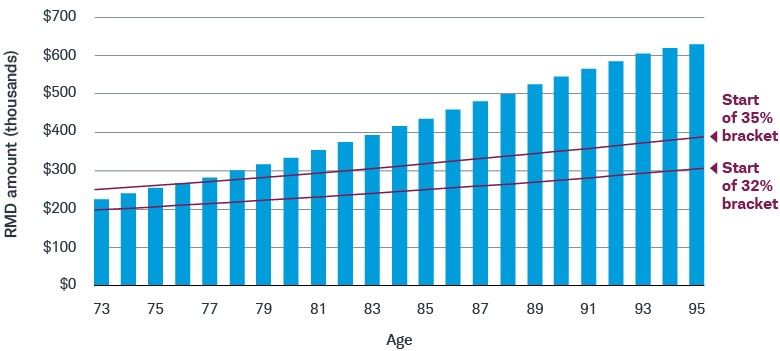
For example, if you're age 73 and had $6 million in tax-deferred retirement savings at the end of 2025, your RMD would be more than $226,000 in 2026—and that amount could rise sharply in future years. Combine that taxable RMD with other income like capital gains, dividends, interest, or Social Security benefits (of which up to 85% could be taxable), and you may see the dream of a lower tax bracket slip away.
A steep ascent
RMDs tend to increase as you age, potentially exposing you to higher federal income tax brackets.
Source: Traditional IRA RMD calculator, Schwab.com.
Assumes a 73-year-old single filer with a nonspouse beneficiary, a $6 million account balance at the end of the prior year, and a 6% average annual portfolio return. The tax brackets are based on federal tax rates as of 12/31/2025 and increase by 2% annually to account for inflation. Only tax brackets relevant to this example are shown. This hypothetical example is only for illustrative purposes.
The potential solution: Greater control over your income in retirement
There are three primary strategies for avoiding a level of RMDs that could move you into an unwanted tax bracket and owing a potentially higher tax bill:
- Roth 401(k) contributions: If you're still working, you might consider switching from pretax 401(k) contributions to after-tax Roth 401(k) contributions, since Roths aren't subject to RMDs. Plus, withdrawals from Roth accounts are generally tax-free (state tax treatment may vary) so long as you're at least age 59½ and have held the account for at least five years. (You can also consider contributing to a Roth IRA for tax year 2026 if your modified adjusted gross income is less than $168,000 as an individual or less than $252,000 as a married couple filing jointly.)
- Roth IRA conversions: If Roth contributions aren't an option—or if you want to shift even more of your savings into a Roth—you could convert some of your tax-deferred 401(k) or IRA funds to a Roth account. You'll owe income taxes on the converted amount in the year of the conversion, but you won't face RMDs or owe taxes on future qualified withdrawals, including any appreciation.
- Early retirement withdrawals: Once you reach age 59½, you can make penalty-free withdrawals from your tax-deferred accounts. Doing so will result in ordinary income taxes on the withdrawals, but the money could then be invested in a taxable account for future potential growth. Although annual income and any realized appreciation from such accounts will also be taxed, you can use realized losses to help offset other capital gains and potentially up to $3,000 in ordinary income on your tax return per year—an investment strategy known as tax-loss harvesting—which isn't true of tax-advantaged 401(k)s and IRAs.
The challenge: Your income is unusually low in a given year
A low-income year—owing to a period of unemployment, a significant business loss, or perhaps a smaller bonus—is never ideal but may also land you in a lower tax bracket.
The potential solution: When life hands you lemons, make lemonade
There are ways to take advantage of a temporary decline in income that could provide some tax relief for your future self:
- Targeted Roth conversions: Converting just enough of your tax-deferred 401(k) or IRA to fill out your current tax bracket without tipping into a higher one could help minimize future tax payments by potentially reducing RMDs.
- Tax-gain harvesting: Strategically selling highly appreciated securities while you're in a lower tax bracket can possibly lower your long-term capital gains rate—currently 0%, 15%, or 20%, depending on your taxable income and filing status. Further offsetting those gains through tax-loss harvesting could also potentially lighten your tax load.
The challenge: You want to reduce estate taxes for your heirs
When you pass down tax-deferred assets, beneficiaries generally are required to liquidate the accounts within 10 years of your death, and any distributions will be subject to ordinary income taxes—a potentially big tax hit if the account value is high.
The potential solution: Create an income-tax-free investment vehicle
Because Roth accounts generally offer tax-free qualified distributions, they are among the most valuable assets you can leave to your heirs:
- Roth conversions for legacy planning: While you'll pay taxes now on the converted assets, qualified withdrawals are income-tax-free for heirs. Most nonspouse heirs must still draw down the funds within 10 years, but those withdrawals won't add to their taxable income—which can be particularly powerful for those in high tax brackets.
The power of tax diversification
Even if you're not worried about future taxes, it's still a good idea to have a variety of savings options with different tax treatments—both to better control your retirement income and to pass on assets to the next generation as tax-efficiently as possible. Before taking action, be sure to discuss your situation with a qualified tax professional and wealth advisor.
A few reminders about Roth conversions
- Under the contribution rule, at least one of your Roth IRAs must be initially funded for a minimum of five tax years before you can withdraw earnings tax-free, regardless of your age.
- Under the conversion rule, if you're under age 59½, you may owe a 10% penalty on any withdrawals of principal or earnings within a separate five-year window that begins on January 1 the year of conversion.
- Taxes are due on any portion of the converted amount that was funded with pretax dollars or is related to earnings and appreciation. If you have multiple IRA accounts, the pro rata rule will be used to determine the taxable portion of a conversion. This rule treats all IRA funds as a single bucket of money when determining the taxable portion of a conversion, which means you cannot convert only after-tax contributions.
- There are two five-year rules that impact Roth conversions—though some exemptions may apply:
- Under the contribution rule, at least one of your Roth IRAs must be initially funded for a minimum of five tax years before you can withdraw earnings tax-free, regardless of your age.
- Under the conversion rule, if you're under age 59½, you may owe a 10% penalty on any withdrawals of principal or earnings within a separate five-year window that begins on January 1 the year of conversion.
- And finally: Roth conversions are irreversible, which is why we recommend working with a tax professional or wealth advisor before initiating a conversion.
- Taxes are due on any portion of the converted amount that was funded with pretax dollars or is related to earnings and appreciation. If you have multiple IRA accounts, the pro rata rule will be used to determine the taxable portion of a conversion. This rule treats all IRA funds as a single bucket of money when determining the taxable portion of a conversion, which means you cannot convert only after-tax contributions.
- There are two five-year rules that impact Roth conversions—though some exemptions may apply:
- Under the contribution rule, at least one of your Roth IRAs must be initially funded for a minimum of five tax years before you can withdraw earnings tax-free, regardless of your age.
- Under the conversion rule, if you're under age 59½, you may owe a 10% penalty on any withdrawals of principal or earnings within a separate five-year window that begins on January 1 the year of conversion.
- And finally: Roth conversions are irreversible, which is why we recommend working with a tax professional or wealth advisor before initiating a conversion.
- Under the contribution rule, at least one of your Roth IRAs must be initially funded for a minimum of five tax years before you can withdraw earnings tax-free, regardless of your age.
- Under the conversion rule, if you're under age 59½, you may owe a 10% penalty on any withdrawals of principal or earnings within a separate five-year window that begins on January 1 the year of conversion.