Stocks Rise Early as Oil Prices, Yields Fall
Published as of: September 21, 2026, 9:10 a.m. ET
Listen to this update
Listen here or subscribe to the Schwab Market Update in your favorite podcast app.
| The markets | Last price | Change | % change |
|---|---|---|---|
| S&P 500® Index | 7,650.50 | +12.74 | +0.17% |
| Dow Jones Industrial Average® | 51,682.64 | -95.40 | -0.18% |
| Nasdaq Composite® | 26,522.55 | +104.25 | +0.39% |
| 10-year Treasury yield | 4.97% | -0.03 | -- |
| U.S. Dollar Index | 100.27 | +0.05 | +0.05% |
| Cboe Volatility Index® | 14.86 | +0.05 | +0.34% |
| Gold | $4,394.70 | -$30.20 | -0.68% |
| WTI Crude Oil | $93.46 | -$2.62 | -2.73% |
| Bitcoin | $85,221 | +$4,052 | +4.99% |
(Monday market open) Stocks rose in early trading Monday as oil prices and Treasury yields fell, a positive start to a week with minimal economic data and earnings reports due. Chipmakers rose as the AI trade appeared to regain its footing.
Volatility has been light despite recent market weakness. That could change this week as position shifting occurs before the end of the quarter in what's traditionally called "window dressing" season. That's when fund managers shift in and out of stocks before sending quarterly reports to clients.
Major indexes finished mixed Friday to end a slightly lower week for the broader market that included the Federal Reserve's first hike since 2023. While that eased fears that Fed Chairman Kevin Warsh wouldn't actively fight inflation, Treasury yields didn't bend much, ending the week at 5% for the 10-year Treasury note. Several Fed speakers might provide more nuance on the hike. And this Thursday's meeting between President Trump and Chinese President Xi could feature tariff reduction news, Reuters reported.
To get the Schwab Market Update in your inbox every morning, subscribe on Schwab.com.
Three things to watch
- S&P Global U.S. PMI data looms: Wednesday brings a look at the U.S. manufacturing economy courtesy of S&P Global. This report sometimes gets overlooked due to competing ISM Manufacturing PMI® numbers and is compiled differently. S&P Global surveys a larger number of companies, around 1,200 versus 800 for ISM, making it a bit more representative in terms of U.S. manufacturing. In addition, ISM's surveys are based on data from purchasing and supply executives while S&P Global's includes a broader spectrum of job titles, including CEOs and CFOs. "So you get a little bit of a more robust flavor," said Liz Ann Sonders, chief investment strategist at the Schwab Cener for Financial Research (SCFR), in her latest podcast. "ISM has a longer track record and a longer history of doing this survey, but I would say that S&P Global is growing in importance because it actually has done a little bit better a job at providing kind of real-time signals and a little bit less noise, and that helps to just figure out whether you're at an inflection point or not."
- Consumer firms line up to report: The earnings calendar picks up slightly this week with consumer companies at the register. AutoZone (AZO), KB Home (KBH), Darden Restaurants (DRI), and Costco (COST) all report. It's been a tough climate for restaurants due to rising menu prices that hit customers just as they faced higher interest payments on credit card and auto loans thanks to accelerating Treasury yields. Those same high yields put mortgage rates above 7% recently, hurting the housing sector. Another blow for housing was the Fed's rate hike last week. Though this week's reports provide a snapshot, earnings are mainly in hibernation, especially on the tech side where results often affect overall market sentiment. Speaking of which, the latest AAII Investor Sentiment Survey pointed heavily toward the negative side. Respondents who called themselves "bearish" rose to 53.3%, the highest since May 2025. This could help explain the recent sharp decline in market breadth. Last week ended with only around 30% of S&P 500 stocks above their 50-day moving average.
- The end of an era: Warren Buffett, the 96-year-old former CEO of Berkshire Hathaway (BRK/A), said Friday that he's stepping down as chairman of the company he's led for more than 60 years. Buffett, who handed over the CEO role nine months ago to Greg Abel, will remain on the board of directors while his son Howard succeeds him in the chair role. The Oracle of Omaha leaves a staggering legacy and large shoes to fill; under his leadership, Berkshire shares produced an annual return of 19.7%, roughly double that of the benchmark S&P 500. In response to the news, Berkshire shares dipped modestly in Friday's session. Throughout his tenure, Buffett maintained some unconventional traditions, such as never splitting Berkshire's Class A stock (currently trading around $764,000 a share), reporting earnings on Saturdays, and keeping the company's public-facing website incredibly spartan. Time will tell if practices evolve in the wake of the titan's graceful move to the chairman emeritus role.
On the move
- Oil prices fell after the U.S. claimed shipments through the Strait of Hormuz had reached a six-month high, and concerns about disruptions to Saudi oil shipments eased. WTI and Brent crude oil futures both lost nearly 3% in early trading.
- Chip stocks moved higher in early trading, with Arm Holdings (ARM) and Western Digital (WDC) both gaining more than 2% before the opening bell. Chip stocks gained toward the end of last week as AI fears eased amid positive talk from Arm and Nvidia (NVDA). Other names trending higher Friday included Sandisk (SNDK), Lumentum (LITE), and Texas Instruments (TXN).
- Crypto-related companies Strategy (MSTR) and Coinbase (COIN) both jumped by 5% or more as bitcoin hit its highest level since January. Both companies rose by double-digit percentages Friday as crypto stocks tracked bitcoin higher after the SEC offered an exemption that allows companies to offer trading in blockchain-based, or tokenized, stocks, Reuters reported.
- Shares in Paramount (PSKY) rose more than 5% and Warner Bros. (WBD) gained more than 7% in early trading after The Wall Street Journal reported that Paramount and the state of California had discussed settling a lawsuit that was blocking Paramount's merger with Warner Bros.
- Accenture (ACN) rose nearly 5% before the bell after the company said Friday it would partner with Anthropic and evaluate its AI models.
- Novo Nordisk (NVO) fell more than 4% in early trading after the company outlined its plans to revive growth in the anti-obesity drug market.
- Automakers including General Motors (GM) and Ford (F) fell moderately Friday in what appeared to be technical trading.
- Steel makers Nucor (NUE) and Steel Dynamics (STLD) fell 6% and 4% Friday after both companies issued third-quarter earnings guidance that fell short of consensus.
- The Nasdaq, dominated by tech, hasn't made a new high since early June and is down about 2% since then, though it's been stable and trading in a tight range for more than a month. With tech not contributing, the broader S&P 500 Index has faced trouble making higher moves. Technical support remains near 7,600, just below the 50-day moving average.
More insights from Schwab

Rate hike and Wall Street: In the latest Schwab Market Perspective, our experts discuss how Fed tightening has historically affected the markets and how European stocks may be worth a second look.
" id="body_disclosure--media_disclosure--203671" >Rate hike and Wall Street: In the latest Schwab Market Perspective, our experts discuss how Fed tightening has historically affected the markets and how European stocks may be worth a second look.
The disclosure dilemma: Worried about oversharing? What if not sharing is the bigger mistake? The latest episode of Choiceology dives into the surprising costs of keeping quiet and why we misjudge the risks of revealing our true selves.
Chart of the day
Data source: ICE. Chart source: thinkorswim® platform.
Past performance is no guarantee of future results.
For illustrative purposes only.
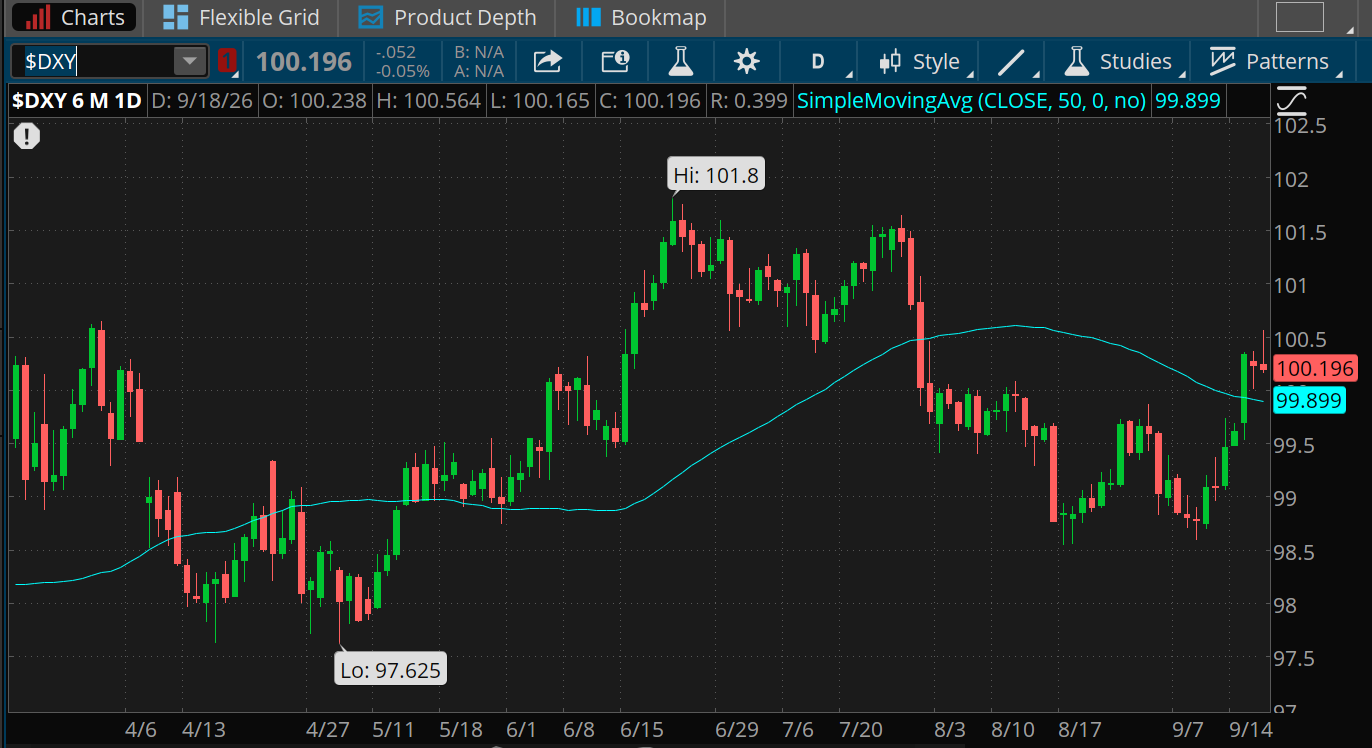
The U.S. Dollar Index ($DXY—candlesticks) hit six-week highs last week after the Fed raised rates. It climbed above 100 and topped its 50-day moving average (blue line) for the first time since late July. A weaker yen also helped, as the yen sank when two Bank of Japan policymakers opposed the BOJ's hike. A rising dollar might also reflect relatively resilient U.S. economic data this month, but bigger move might hurt earnings for multi-national U.S. firms. This wouldn't likely be the case unless the dollar soared to 105 or higher, where it hasn't been since early 2025.
The week ahead
September 22: Earnings expected from AutoZone (AZO) and KB Home (KBH).
September 23: Expected earnings from Cintas (CTAS), Paychex (PAYX), and General Mills (GIS).
September 24: August new home sales and expected earnings from Darden Restaurants (DRI) and Costco (COST).
September 25: August durable goods orders and final September University of Michigan Consumer Sentiment.
September 28: Expected earnings from Jefferies Financial Group (JEF).