Stock Index Futures Tick Values Explained
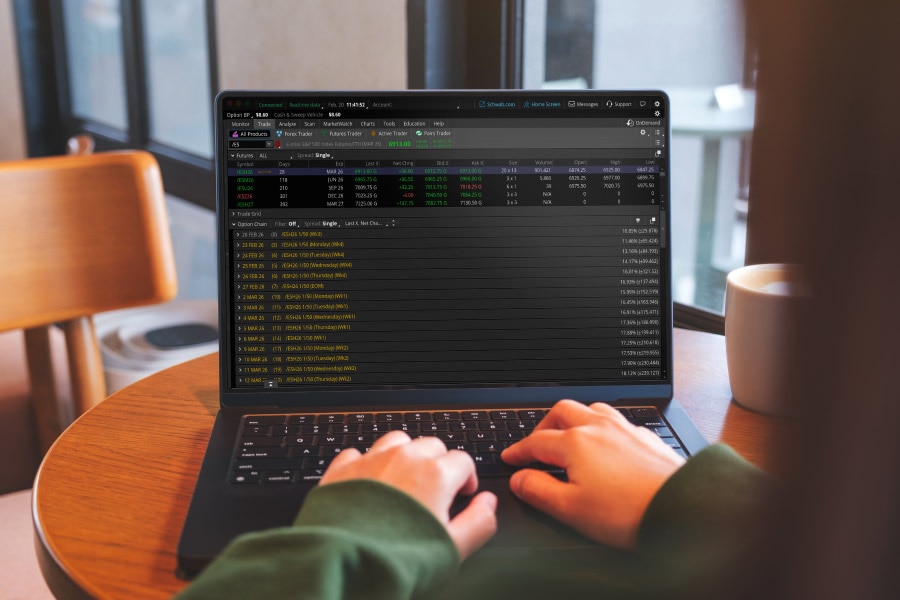
Like a scorecard at a baseball game, tick sizes are a fundamental scorekeeping mechanism for trading the markets. Instead of recording hits, runs, and runs batted in, tick sizes help traders track price fluctuations, define risk, and calculate profits or losses.
For equities, tick sizes are straightforward—they're the minimum price increment by which a stock can move, usually $0.01 for stocks priced at or above $1. The total value of a tick for a given position is this minimum price increment multiplied by the number of shares held. But for stock index futures based on the S&P 500® Index (SPX) and other benchmarks, the scoring rules are a bit more complicated.
What is a futures tick size?
A futures contract's minimum price fluctuation, or tick size, can vary depending on the type of contract, the exchange, the size of the financial instrument, and the requirements of the marketplace. Tick sizes are part of a futures contract's specifications—rules set by futures exchanges like the CME Group—that are calibrated to encourage efficient price discovery, liquid markets, and tight bid/ask spreads.
As with stocks or other assets, it's important for investors to keep tabs on how much an investment or position gains or loses over the course of an hour, a day, or other time period. Those unfamiliar with a contract's tick size may struggle to accurately size positions or implement effective risk management strategies. Understanding how price changes will affect a contract's value is a basic first step for futures traders—and that means understanding tick sizes.
Index futures contract specs
The table below shows key specifications—contract size, tick size, and tick value—for some of the most popular equity futures index contracts as of February 19, 2026.
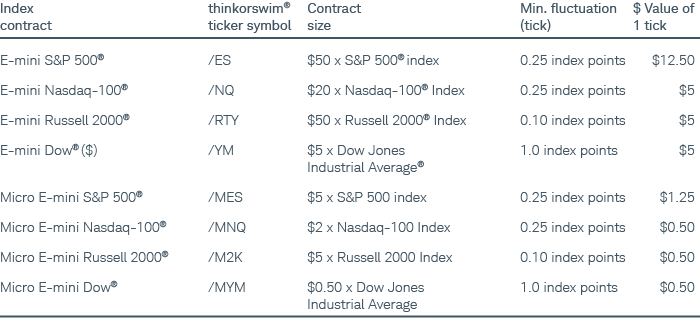
For illustrative purposes only. Not a recommendation. Note: The minimum price fluctuations (ticks) listed are for outright trades. Tick sizes may be different for TACO (Trade at Cash Open), BTIC (Basis Trade at Index Close), and TMAC (Trade Marker at Close) trades as well as calendar spreads.
Doing the math
Here's an example of how futures tick sizes differ from stocks. Imagine a trader holds 100 shares of a stock trading at $10 per share for a total position value of $1,000. In this case, an increase or decrease of $0.10 equals a gain or loss of $10 ($0.10 x 100).
For E-mini S&P 500 futures (/ES), the contract size is $50 times the index value. So, if the SPX is at 6,500, the notional contract value is $325,000. The minimum tick is one-quarter of an index point, or $12.50 per contract.
If the SPX rises or falls 65 points (approximately 1%), that translates into a gain or loss in the E-mini S&P 500 futures contract of $3,250. This is calculated by dividing the 65-point move by the minimum tick of 0.25 (260 ticks) and multiplying that by $12.50.
Tick sizes and values are also different for CME Group's Micro E-mini equity index futures. Launched in May 2019, Micro E-mini equity index futures contracts are one-tenth the size of standard E-mini equity index futures contracts.
For Micro E-mini S&P 500 futures (/MES), the minimum tick or price fluctuation is also 0.25 but the tick value is $1.25 per contract (one-tenth of the $12.50 per contract of the /ES).
So, if the index moves 65 points, or 1%, that translates into a gain or loss of $325 (65 points/0.25 minimum tick = 260 ticks; 260 x $1.25 = $325).
Other micro contracts include E-mini Nasdaq-100® futures (/MNQ), E-mini Dow Jones® futures (/MYM), and E-mini Russell 2000® futures (/M2K). When trading stock index futures, it can be confusing to track the different contract and tick sizes. To get the latest contract and tick sizes, refer to the specific product page on the CME Group's website and select the SPECS tab.
The takeaway: Why tick values matter
Tick values are more than just an abstract market detail. These values represent real dollars at stake every time prices move. In futures trading, tick sizes can impact which contracts a trader chooses to use, how they navigate risk, their profit and loss calculations, and more. Here are just a few reasons traders should pay close attention to futures tick sizes:
- High tick values can cause large, rapid swings in a trade's profit or loss. Some traders prefer micro futures because the smaller tick sizes make profit and loss swings smaller.
- Stop orders must take tick sizes into account. Setting stop orders that ignore tick sizes may lead to rejected orders or cause traders to take on more risk than planned.
- Tick sizes impact bid/ask spreads, which, in turn, impact trading costs. Smaller tick sizes can potentially lower trading costs, while larger tick sizes may increase them.
- Tick sizes can influence liquidity and should be considered when selecting futures trading strategies. Selecting a trading strategy without considering tick sizes can lead to higher transaction costs, poor order execution, or inaccurate risk analysis.
- Because tick sizes can impact a futures contract's volatility, they may change the margin needed to hold a position.
Ultimately, tick sizes communicate the minimum possible price movement in a futures contract—the real dollars gained or lost—so it's critical to verify the current tick size and associated tick value before entering a trade.
Want to continue learning about trading futures? Check out some of Schwab's Traders Talks Coaching Webcasts.